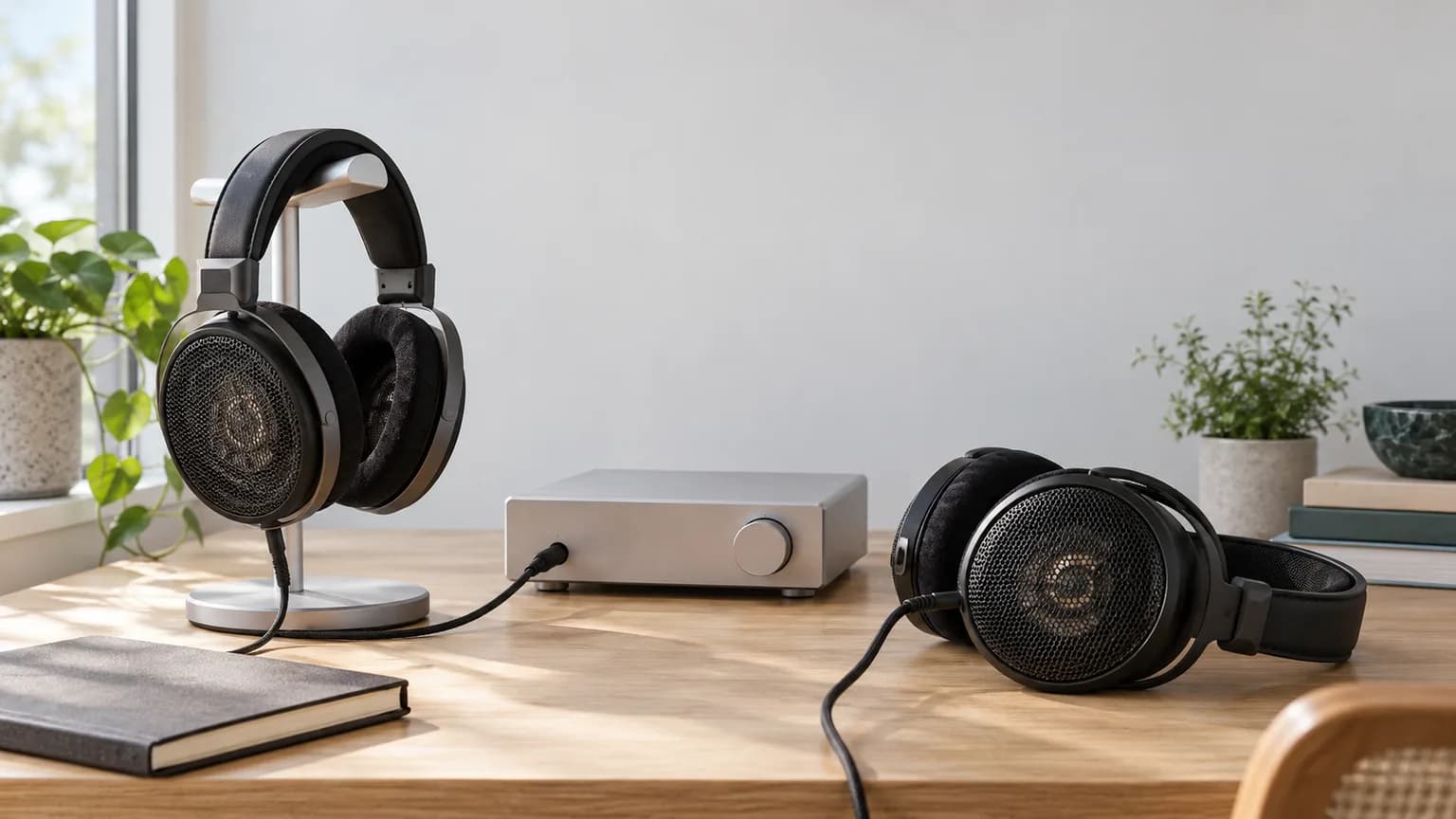
Best Open-Back Headphones for Desk Listening (2026)
Before you ask which sounds best, ask whether your PC can drive it. The Meze Audio 105 AER runs from a laptop jack and tops the expert ratings; plan on an amp only for the harder-to-drive picks.
This article contains affiliate links. We may earn a commission at no extra cost to you. Learn more
Featured in this Guide
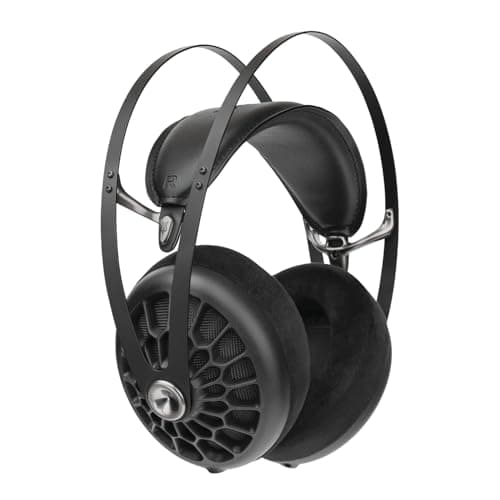
Meze
Audio 105 AER
- •Plugs straight into a laptop jack
- •with what Digital Trends hears as a warm tonality that leaner open-backs lack.
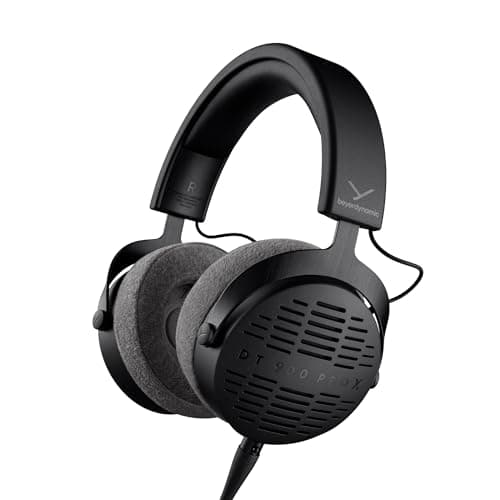
beyerdynamic
DT 900 PRO X
- •Among the lowest-priced picks here
- •and What Hi-Fi? got good volume from a MacBook Pro with no amp in between.
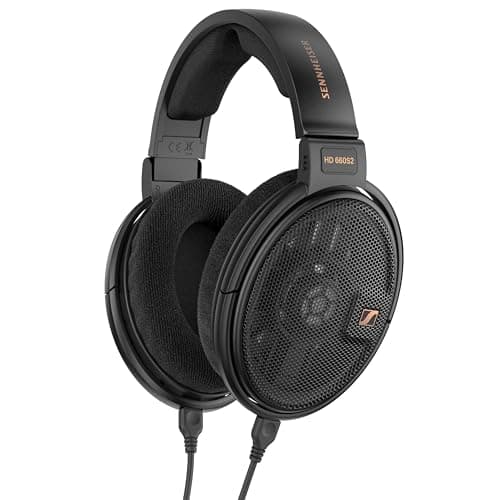
Sennheiser
HD 660S2
- •The same house sound as your HD 600/6XX with more reach. It needs a proper amp
- •which you already have.
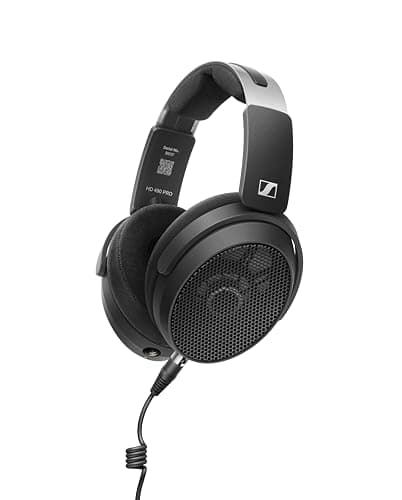
Sennheiser
HD 490 PRO
- •Reviewers single out how light and comfortable it is. Its 8.6 rests on one rated review
- •so weigh that.
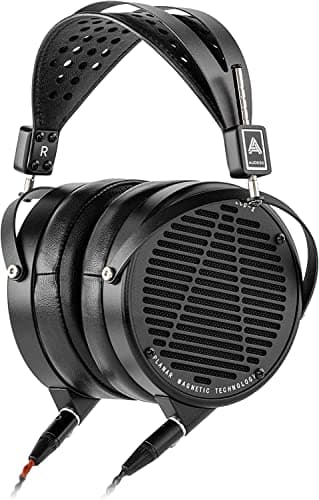
Audeze
LCD-X
- •Planar detail and a tank-like build
- •if the weight is fine with you. Scored from one rated review (TechRadar
- •2021).
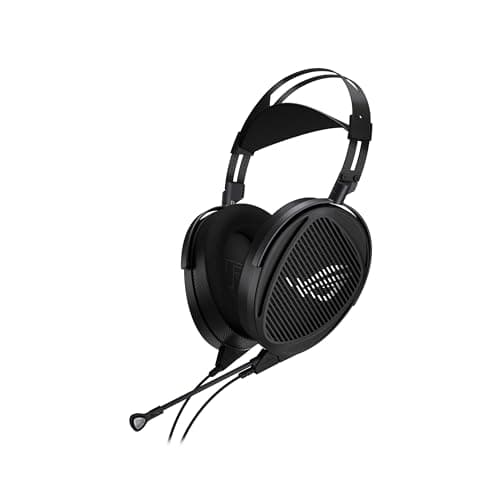
ASUS
ROG Kithara
- •A planar with a detachable boom mic in the box
- •so one cable covers game chat and evening music.
The Short Answer
For most desks, buy the Meze Audio 105 AER: it runs directly from a laptop headphone jack and earned the strongest expert consensus here. Without an amplifier on a tighter budget, choose the beyerdynamic DT 900 PRO X; amplifier owners upgrading from an HD 600/6XX should consider the Sennheiser HD 660S2.
If you have read a few threads about open-back headphones, you have met the Sennheiser HD 600 and HD 650/6XX. They are the reference most upgrade advice starts from, and the baseline this guide measures against rather than a recommendation. Yet the first question buyers actually ask concerns amplification, not sound. One Level1Techs forum member wrote: "If the headphones need a DAC/AMP I would appreciate the heads up and a recommendation for them too as I don’t own any." Every recommendation below answers that question first, using published specifications and reviewer findings.
Comfort after 3 hours comes next, followed by tuning relative to that familiar Sennheiser character. Picture a home desk in the evening, music playing without disturbing anyone else in the house. We ranked ten wired open-backs using the DeskGear Composite Score; noise-cancelling, wireless and call headsets have separate guides, and amplifier recommendations belong elsewhere.
Head-to-Head Comparison
Display & Audio Setup
Chart
 DeskGearHQ.com
Laptop-ready, no amp: Meze Audio 105 AER
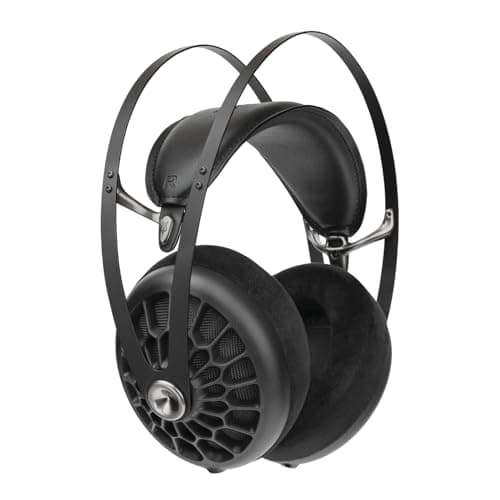
Meze rates the 105 AER at 42 ohms with 112 dB SPL/mW sensitivity, making it one of the easiest headphones here to power from a laptop or desktop jack. Its detachable cable runs about 6 ft. An amplifier is therefore optional from the first day rather than a hidden additional expense. Meze calls it rich-sounding and lush, and Digital Trends hears a warm tonality, which appeals to anyone leaving an HD 6XX who wants more body without sacrificing open-back spaciousness. TechRadar, T3 and Trusted Reviews all awarded perfect scores, and Digital Trends added a strong rating of its own. Expert Consensus is the heaviest-weighted factor in the DeskGear Composite Score, and this headphone leads that measure comfortably. The single repeated caveat concerns size, because TechRadar, T3 and Digital Trends all warn it may prove too large for smaller heads. If your head is on the small side, you may sacrifice a secure fit in exchange for this particular sound.
What We Love
- Gets loud from a laptop or PC jack with no amp, going by Meze's published sensitivity
- Perfect scores from TechRadar, T3 and Trusted Reviews, the strongest agreement here
- TechRadar says it is built and finished to an impressive standard
What Could Be Better
- TechRadar and T3 warn it may be too large for some smaller heads
- Digital Trends hears a warm tonality, so if you want a flat studio reference, look at the beyerdynamics
The Verdict
If you want one open-back that sounds full from the laptop you already own, the Meze Audio 105 AER fits the brief. It has the strongest expert consensus in this guide and needs no amp. The trade: on a smaller head the fit may be loose, so keep the return window in mind.
Neutral, no amp needed: beyerdynamic DT 900 PRO X
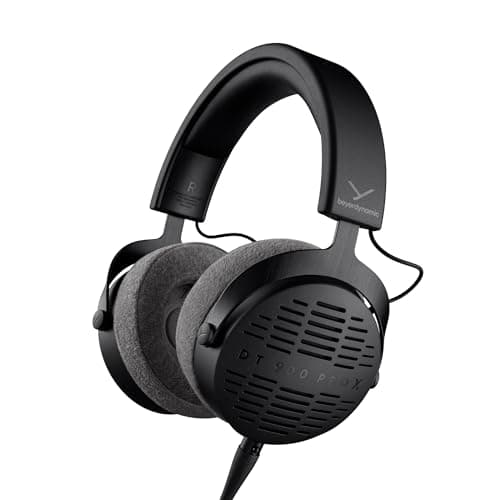
The DT 900 PRO X is rated at 48 ohms, and What Hi-Fi? reported generous listening levels directly from a MacBook Pro, so an amplifier remains optional. That publication awarded full marks, as did T3. SoundGuys was more reserved and listed one con, that the headphone is a bit heavy; beyerdynamic's specification confirms 345 g without the cable. RTINGS rates it very good for neutral listening, with a soundstage that feels wide, spacious and open. What Hi-Fi? cautions that it is demanding of partnering electronics and recording quality, so poorly mastered recordings will reveal their imperfections. Compared to the Meze 105 AER, it exchanges some warmth for a flatter, more analytical presentation. It suits someone who edits audio, writes code or reads documentation for 8 hours at one desk without any budget for an amplifier.
What We Love
- What Hi-Fi? got good listening levels from a MacBook Pro with no amp
- RTINGS calls the build great and the fit comfortable for long office days
- A detachable mini-XLR cable means a damaged lead is an easy swap
What Could Be Better
- SoundGuys lists it as a bit heavy
- What Hi-Fi? calls it demanding of partnering electronics and recording quality
The Verdict
If you're shopping without an amp and want the safest laptop-ready buy, the beyerdynamic DT 900 PRO X lines up with what you actually need. It plays loud from a laptop, and two outlets gave it full marks. It suits anyone who listens at the same desk all day.
Comfort over everything: Sennheiser HD 490 PRO
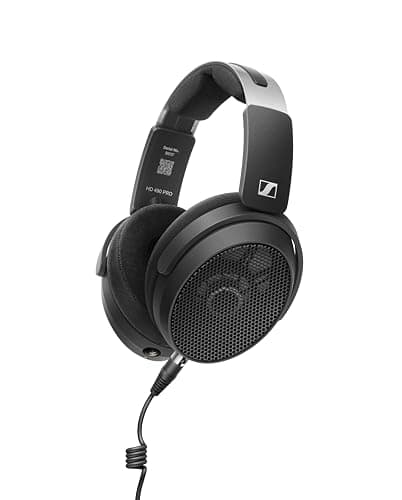
Sennheiser rates the HD 490 PRO at 130 ohms, roughly 3x the impedance of the Mezes yet considerably below the demanding HD 660S2. SoundGuys reported that laptop volume was adequate, but RTINGS made no amplification statement, so consider a laptop workable rather than ideal. Comfort is the real argument. RTINGS calls it very comfortable and lighter on the head than several open-backs, and SoundGuys lists lightweight and comfortable as a pro. Sennheiser specifies 260 g, which matters most during sessions beyond 3 hours. The single con SoundGuys listed is that the ear pads are difficult to exchange. Interpret its DeskGear Composite Score carefully: it rests on one rated review from SoundGuys, an outlet that scores this category well below the star-rating publications. That reflects the calculation, not experts rating it below the HD 660S2. If comfort is the specification that decides it for you, this is the headphone to buy.
What We Love
- RTINGS calls it very comfortable; SoundGuys lists lightweight and comfortable as a pro
- Sennheiser lists it at 260 g, among the lightest open-backs here
- Two sets of ear pads come in the box
What Could Be Better
- SoundGuys found the ear pads difficult to swap
- Its score rests on one rated review (SoundGuys), so it is less settled than the top two
The Verdict
For long sessions where comfort decides everything, the Sennheiser HD 490 PRO is a sensible pick for that setup. Reviewers agree on how light and easy it is to wear, though its 8.6 is based on one rated review. This is the one if comfort outranks every other spec.
Planar, weight is fine: Audeze LCD-X
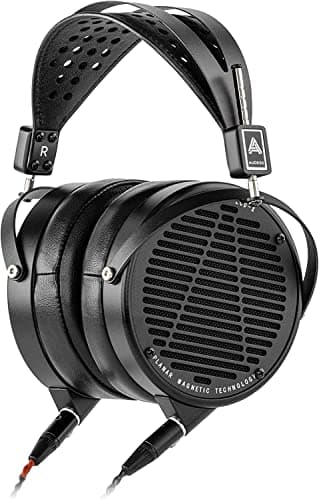
Audeze rates the LCD-X at 20 ohms, which appears effortless on paper, yet TechRadar still lists a headphone amplifier as a requirement among its cons. The driveability section explains why planar designs can demand more current than their impedance suggests. Weight is the bigger decision, since at 612 g it is the heaviest pick here and more than 2x the HD 490 PRO. RTINGS is more forgiving than you might expect, describing it as heavy but comfortable enough for all-day desk wear, with a warm presentation that can reduce listening fatigue. TechRadar praised its tank-like build and serviceability, while cautioning that the laid-back sound is not for everyone. Its score rests on one rated review, a nearly 5-year-old TechRadar assessment published in December 2021. Relative to the Focal Clear MG, the LCD-X delivers planar bass at the cost of considerably more weight and a genuine amplifier requirement.
What We Love
- TechRadar praises its tank-like build and serviceability
- RTINGS says it is comfortable enough for all-day wear at a desk, despite the weight
- A warm sound that RTINGS says can reduce ear fatigue over long sessions
What Could Be Better
- The heaviest pick in this guide, and TechRadar's cons say so plainly
- TechRadar says it requires an amp and calls the laid-back sound not for everyone
The Verdict
If you're curious about planars and already have an amp, the Audeze LCD-X checks the boxes that matter: detail, a tank-like build and an all-day fit RTINGS rates comfortable. Next to the Focal Clear MG, you give up a lighter frame and easier drive to get planar bass.
Desk gamer, mic in the box: ASUS ROG Kithara
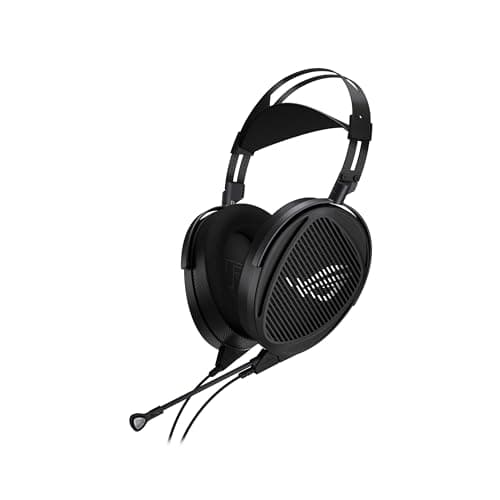
The ROG Kithara is the only pick here with a boom microphone included, and one of only two planar designs. We could not confirm the manufacturer's own specifications. However, Stuff and SoundGuys both report a 16-ohm impedance, and SoundGuys concludes that a dedicated amplifier is unnecessary despite the substantial planar driver. Stuff similarly writes that it is just as at home on a laptop as on a high-grade amplifier. Reviewers disagree about the microphone: Stuff and SoundGuys praise it, while Tom's Guide considers it poor. Consider it adequate for multiplayer communication, and choose a dedicated conferencing headset if professional meetings dominate your schedule. Comfort fares better: RTINGS says it is comfortable to wear long term in a quiet room, which matters considerably across 3 hours of evening gaming. Tom's Guide likewise lists lightweight and comfy as a pro. Reviewers nevertheless measure it at 420 g (the Amazon listing says 11.2 oz), and SoundGuys calls it a bit hefty. Published ratings range from a lukewarm assessment at Tom's Guide to four-star evaluations from TechRadar and Stuff. You get a planar and a microphone in one package, sacrificing the build quality of the pricier alternatives.
What We Love
- A detachable boom mic in the box, which Stuff and SoundGuys both rate well
- Stuff and SoundGuys report 16 ohms, and SoundGuys says it needs no dedicated amp
- RTINGS says it is comfortable long term; Tom's Guide calls it lightweight and comfy
What Could Be Better
- Tom's Guide lists a cheap build and headband
- SoundGuys calls it a bit hefty at 420 g, though it found it comfortable for over 4 hours
The Verdict
If you game at your desk and want one headset for chat and music, the ASUS ROG Kithara lines up with that setup. It puts a planar and a boom mic in one box. The trade is build: Tom's Guide calls the build and headband cheap, and reviewers split on the mic.
Endgame dynamic, small amp: Focal Clear MG
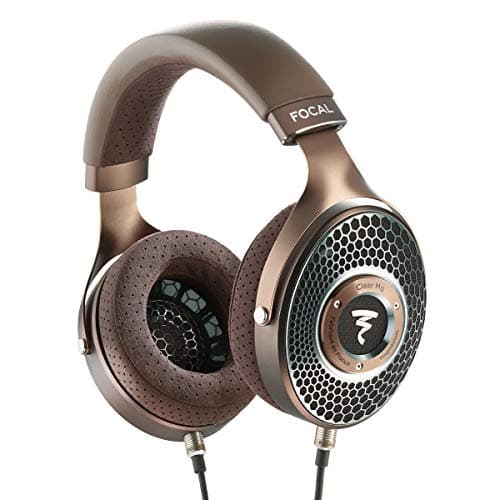
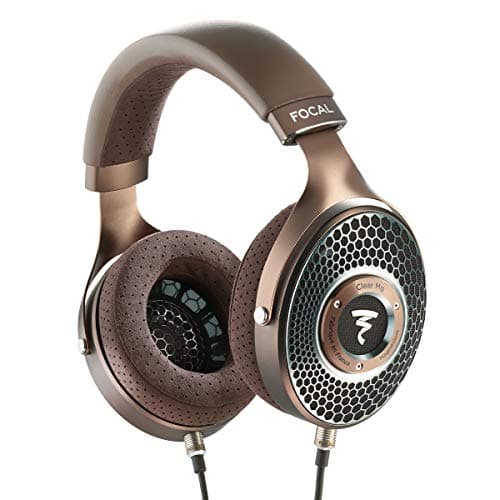
The specification sheet at headphones dot com lists the Clear MG at 55 ohms and 104 dB SPL/mW, and TechRadar and T3 both name easy to drive among its advantages. That enables you to run it from a decent laptop or interface output and add an amplifier later if you choose. Three publications adore it, with What Hi-Fi? and T3 awarding full marks and TechRadar nearly matching them, while SoundGuys scored it far lower, consistent with how that outlet treats the entire category. At 450 g by What Hi-Fi?'s count, it is noticeably heavier than the Sennheisers, yet What Hi-Fi? calls the comfort excellent. The caveats are modest: TechRadar hears a forward presentation and occasional headband creaking, and T3 suggests it is maybe not totally neutral. Its Durability factor, calculated as 2x the Amazon owner rating, is the lowest in the field, and Value scores low because the price sits at the top. It suits the experienced listener who appreciates energy and detail and wants one headphone to keep indefinitely.
What We Love
- TechRadar and T3 both list easy to drive as a pro
- What Hi-Fi? calls the comfort excellent; RTINGS says it is very well built
- Ships with both a 3.5 mm cable and a 4-pin XLR balanced cable
What Could Be Better
- TechRadar notes a forward presentation, and T3 says it is maybe not totally neutral
- TechRadar heard some creaking from the headband
The Verdict
If you want a flagship dynamic but don't want to build your desk around a big amp, the Focal Clear MG is the path of least friction. Reviewers call it easy to drive and comfortable. It's for the listener who already knows what they like and wants one last step up.
Own an HD 600/6XX and an amp: Sennheiser HD 660S2
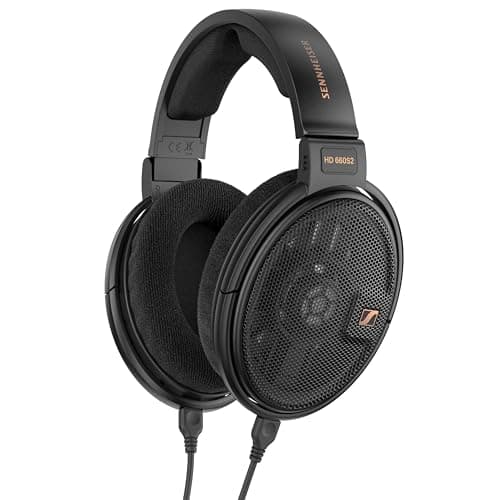
Sennheiser specifies 300 ohms of impedance for the HD 660S2, more than 2x the HD 490 PRO. Both RTINGS and TechRadar say it needs a dedicated amplifier to perform at its best, which is precisely why it suits listeners already owning a capable amplifier. Sennheiser also specifies a 38 mm transducer, so disregard the larger figure appearing on the Amazon listing. Reviewers disagree considerably about the bass: What Hi-Fi? considers it soft, whereas PCMag and Digital Trends describe genuine depth. A forum regular characterizes the 6XX and 650 as "a tad warm with less deep bass." RTINGS describes the 660S2 as flat and slightly warm, so expect familiar Sennheiser character rather than a different personality. Digital Trends adds that the clamping force may feel excessive, which is worth considering if you wear glasses every day. Seven publications evaluated it, the most in this roundup, with SoundGuys the noticeable low outlier. If you already own an amplifier and love the 6XX, this is the logical upgrade.
What We Love
- PCMag and Digital Trends both credit its bass with real depth
- Ships with a 6.3 mm cable and a 4.4 mm balanced cable, ready for a balanced amp
- T3 calls it properly made, comfortable and durable
What Could Be Better
- Needs an amp to sound its best; TechRadar and RTINGS both say so
- What Hi-Fi? finds the bass soft, and Digital Trends says the clamp may feel too strong
The Verdict
If you already own an HD 600/6XX and an amp, the Sennheiser HD 660S2 fits the brief: the same house sound with more reach, judged by seven outlets. This is the step up if you'd rather stay in the family than switch brands.
Detail-first reference dynamic, now amp-optional: beyerdynamic DT 1990 PRO MKII
beyerdynamic DT 1990 PRO MKII
(Current price, subject to change)
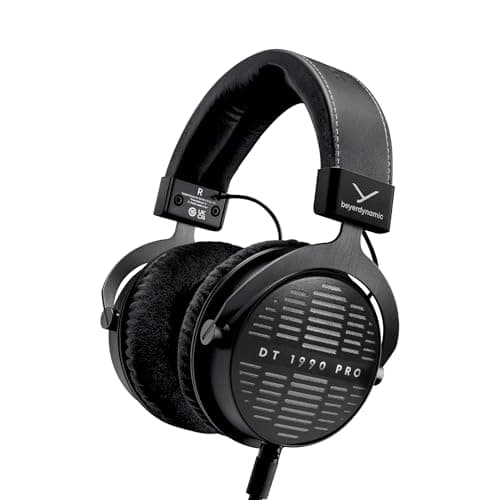
Begin with a correction: the Amazon listing describes the DT 1990 PRO MKII as planar, but beyerdynamic's specification page confirms a dynamic driver. RTINGS said the original DT 1990 PRO required an amplifier, whereas it says the MKII's low impedance makes it usable on most devices without one. SoundGuys likewise concludes that you do not need an amplifier. The compromises are clearly documented. SoundGuys flags very prominent treble and lists mass as a con, and beyerdynamic specifies 376 g, which outweighs the DT 900 PRO X by 31 grams. SoundGuys also notes that the mini-XLR cable is difficult to replace, while praising the overall build quality. Its DeskGear Composite Score rests on one rated review from SoundGuys, which scores the whole category conservatively. Versus the DT 900 PRO X, it is heavier and brighter. Choose it if you mix or edit for 8 hours a day and want that extra analytical edge.
What We Love
- RTINGS says its low impedance makes it usable on most devices without an amp
- SoundGuys asks whether you need an amp for it and answers no
- SoundGuys lists build quality as a pro
What Could Be Better
- SoundGuys flags very prominent treble, which can tire some ears
- SoundGuys lists its mass as a con, and says the mini-XLR cable is hard to replace
The Verdict
If a revealing, reference-style sound matters more to you than warmth and you'd rather skip the amp, the beyerdynamic DT 1990 PRO MKII fits the brief. Its score rests on one rated review. Next to the DT 900 PRO X, it trades some comfort for a brighter top end.
How We Score: DeskGear Score
DeskGear Score
Score Formula
DeskGear Score = (Expert Consensus × 0.30) + (Effectiveness × 0.25) + (Build Safety × 0.20) + (Durability × 0.15) + (Value × 0.10)Score Factors
- Expert Consensus (30%)How strongly the trade-review, ergonomics-research, and specialist sources we cite endorse the product or its category. The single largest weight, because it is the only factor that doesn't depend on a single editor's judgment.
- Effectiveness (25%)Whether the product actually does what its category requires, judged against the functional standards described in the source stack (e.g., monitor color accuracy adequate for design work; chair adjustment range covering the body sizes the spec sheet advertises).
- Build Safety (20%)Electrical, material, and structural soundness for daily desk use: UL/ETL certification, off-gassing disclosures, BIFMA testing, wattage-handling claims, and known failure modes. A safety shortcoming caps the score regardless of effectiveness.
- Durability (15%)Build quality and longevity, triangulated from manufacturer documentation, brand warranty terms, and practitioner-community failure reports across multiple years of 8h/day use.
- Value (10%)Price relative to the field, on the dated lastProductCheck shown in every guide. Re-checked monthly; we update the score if the price-to-field relationship moves.
DeskGear Score — Ranked
Meze Audio 105 AER
9.4/10Strongest expert agreement here and needs no amp; the only caveat is fit on smaller heads.
beyerdynamic DT 900 PRO X
9.2/10Two full-marks reviews and laptop-ready; slightly heavy on the head.
Sennheiser HD 490 PRO
8.6/10Top comfort marks; score based on one rated review (SoundGuys).
Audeze LCD-X
8.6/10Planar detail and build; heavy, wants an amp, scored from one 2021 review.
ASUS ROG Kithara
8.6/10Planar plus boom mic; reviewers knock the build and split on the mic.
Focal Clear MG
8.5/10Easy-to-drive flagship dynamic; value pulls it down at its price.
Sennheiser HD 660S2
8.4/10Most-reviewed pick; wants an amp, and the bass verdict is split.
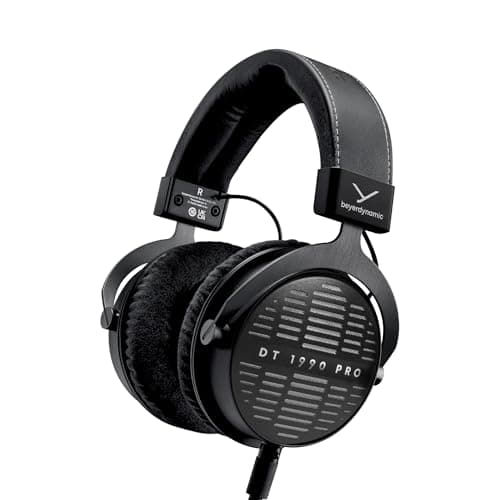
beyerdynamic DT 1990 PRO MKII
8.1/10Laptop-friendly and revealing but bright; based on one rated review.
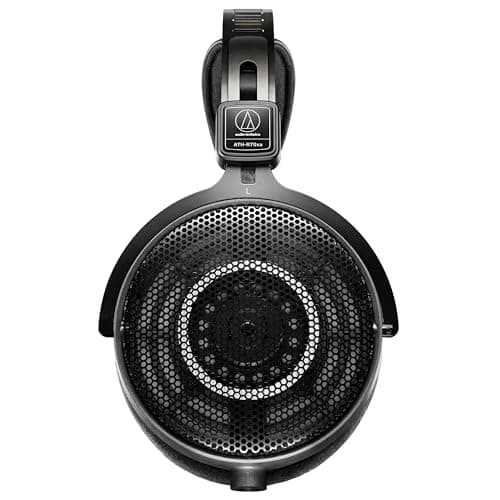
Audio-Technica ATH-R70xa
8.1/10Light and neutral-leaning but needs an amp; based on one rated review (Tom's Guide).
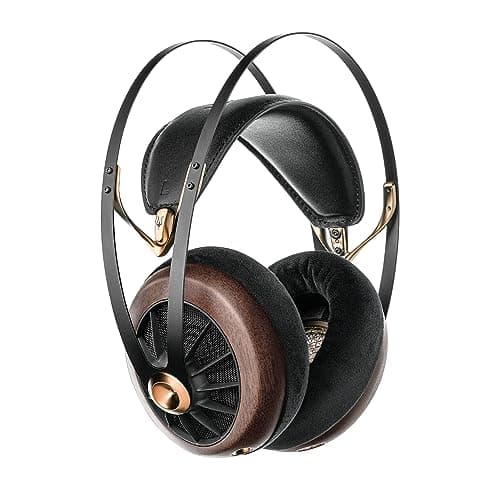
Meze Audio 109 PRO
8.0/10Easy to drive from a computer; a touch trebly per its one rated review (SoundGuys).
Do open-back headphones need an amp?
On the headphones.com forum, experienced owners usually open with one question: "Do you plan on driving them directly from your pc, or do you have a dac/ amp?" Two published specifications answer most of it. Impedance, measured in ohms, describes electrical resistance, while sensitivity describes loudness for a given input. Manufacturers quote sensitivity either per milliwatt or per volt, and those units are not directly comparable, so we never rank headphones across them. As published, the Meze 105 AER and 109 PRO measure 42 and 40 ohms respectively, both rated 112 dB SPL/mW. The beyerdynamic DT 900 PRO X measures 48 ohms and the DT 1990 PRO MKII 30 ohms. The Focal Clear MG measures 55 ohms, the Sennheiser HD 490 PRO 130 ohms, and the Sennheiser HD 660S2 300 ohms, about 7x the Meze 105 AER. Amazon lists the ATH-R70xa at 470 ohms, roughly 11x the Meze, because Audio-Technica's own page would not load for us. We could not confirm ASUS's own figures for the ROG Kithara, but Stuff and SoundGuys both report 16 ohms, the lowest here. Impedance alone does not determine loudness, but reviewers confirm the pattern. The low-impedance Mezes and beyerdynamics play comfortably from a laptop, and SoundGuys says the Kithara needs no dedicated amplifier. RTINGS says the HD 660S2 needs a headphone amp, and TechRadar says most phones and laptops won't get the best from it.
Low impedance does not automatically guarantee easy amplification. The Audeze LCD-X is rated at 20 ohms, yet TechRadar lists a headphone amplifier as a requirement among its cons. Planar drivers are often less sensitive, so they demand more current to reach the same volume with comfortable headroom. A laptop jack typically runs short of current before it runs short of voltage. Choosing the LCD-X or the HD 660S2 therefore results in an amplifier on your shopping list. The chart's Drive Ease row scores this from cited reviews only. A 10 means a reviewer says it performs well without a dedicated amplifier. Digital Trends says so for the Meze 105 AER and T3 for the DT 900 PRO X. SoundGuys reaches the same conclusion about the Kithara, which the chart omits. A 7 means an amplifier helps but isn't required, and a 4 means a reviewer says it requires a dedicated amplifier: RTINGS for the HD 660S2, TechRadar for the LCD-X. A separate desktop DAC and amplifier guide is in preparation, so this guide deliberately names no amplifier products. If you are choosing an audio interface for your desk, see Best XLR Audio Interfaces for Content Creators (2026); for somewhere to store a pair between sessions, see Best Headphone Stands and Mounts (2026).
Two ranked picks have no product card in this guide, so their remaining specifications appear here instead. According to its Amazon listing, the Audio-Technica ATH-R70xa is the lightest headphone in this comparison, weighing 199 g with a 3 m cable. However, Tom's Guide considers its construction and headband engineering noticeably flimsy. SoundGuys lists the Meze 109 PRO at 375 g with both 1.5 m and 3 m cables included, and describes its overall presentation as a touch trebly.
Dynamic vs planar: what changes at your desk
Eight of the ten picks use dynamic drivers; the Audeze LCD-X and ASUS ROG Kithara are the planar alternatives. Dynamic designs here are generally lighter and easier to power from a laptop, which explains why most no-amplifier picks are dynamic. Their typical weakness is the deepest bass, and one headphones.com forum member observed: "Like most other open dynamic headphones, the HD560S is rolled off in the sub-bass." Planar designs often deliver more even low-frequency extension, but the LCD-X illustrates the cost, weighing nearly 2x the Meze 105 AER and requiring an amplifier. The Kithara is the exception on power: reviewers report 16 ohms and SoundGuys says it needs no dedicated amp, though at 420 g it is no lightweight. Tuning matters as much as driver type. Digital Trends hears the Meze 105 AER as warm, the DT 1990 PRO MKII leans bright, and the HD 660S2 stays close to the familiar HD 600 family character.
Forum regulars also recommend HIFIMAN planars, including the Edition XS, Ananda Nano, Arya Stealth and HE1000 Stealth. We could not obtain a rated trade review of these exact models, so they remain Not scored, without product cards or links. Owners frequently describe the Edition XS as a value planar, and one Slickdeals commenter preferred it to the HD 600. One Head-Fi member notes that HIFIMAN "is usually known for a bright and analytical sound", which is worth remembering before auditioning one.
When NOT to Buy
Open-back headphones leak sound in both directions. RTINGS notes that the Focal Clear MG leaks considerable audio that can annoy coworkers and blocks almost no background noise, a limitation shared by open-back designs generally. If you share a room, work in an open-plan office or spend 4 hours a day on calls, choose a different design. For noisy rooms, see Best Noise-Cancelling Headphones for Deep Work (2026); for call-heavy days, see Best Headphones & Headsets for Work From Home 2026: Complete Guide. If you work alone and would rather wear nothing at all, see Best Computer Speakers for Desk Setup 2026: Ultimate Audio Guide.
Who Should Buy What
Who Should Buy What
| If you are… | Recommended pick |
|---|---|
Laptop only, tight budget You have only a laptop, no amp, and want one of the lower-priced picks that reviewers confirm runs loud from it. | beyerdynamic DT 900 PRO X |
Wants a warmer tuning You find Sennheiser and beyerdynamic a bit lean and want the warmer tuning reviewers hear in the 105 AER, with no amp. | Meze Audio 105 AER |
Already owns an amp You already own a headphone amp and an HD 600 or 6XX, and want the family step up. | Sennheiser HD 660S2 |
Long sessions, light on the head You listen for hours, wear glasses, or simply want the lightest-feeling Sennheiser here. | Sennheiser HD 490 PRO |
Wants detail without an amp You want a bright, revealing reference sound and would rather not buy an amp to get it. | beyerdynamic DT 1990 PRO MKII |
Planar curious, weight is fine You have an amp, want planar bass and detail, and the weight doesn't bother you. | Audeze LCD-X |
Desk gamer who needs a mic You game at your desk and want one wired headset with a boom mic in the box. | ASUS ROG Kithara |
Frequently Asked Questions
Do open-back headphones need an amp?
Most of the picks here don't. Going by published specs and reviewers, six run from a laptop or PC jack: the Meze 105 AER and 109 PRO, the beyerdynamic DT 900 PRO X and DT 1990 PRO MKII, the Focal Clear MG and, per SoundGuys, the ASUS ROG Kithara. The Sennheiser HD 660S2, Audio-Technica ATH-R70xa and Audeze LCD-X want an amp. A quick test: if your laptop has to sit near maximum volume for quiet recordings, you'll hear the benefit of more power.
Can I plug open-back headphones straight into my laptop or PC?
Yes, for the low-impedance picks. Laptop jacks vary, and many are fine at moderate volume but get noisy or thin near the limit. If yours hisses or runs out of volume, a small USB DAC usually fixes both without a full desktop stack. The headphone output on an audio interface works too, if one already sits on your desk.
What should I upgrade to from the Sennheiser HD 600 or HD 6XX?
Decide what you'd change about your HD 600 first, because upgrading within the same tuning feels smaller than switching tuning. For the same character with more reach, and an amp you already own, look at the Sennheiser HD 660S2. For warmth with no amp, the Meze Audio 105 AER. For comfort, the Sennheiser HD 490 PRO. For planar bass, the Audeze LCD-X.
Planar magnetic vs dynamic headphones: what is the difference you can hear?
The driver type matters less than people expect. Planars often keep deep bass more even, while open dynamics tend to roll off in the sub-bass. In this guide both planars weigh more than most dynamics, and the LCD-X wants more current, though reviewers say the Kithara runs without an amp. Tuning usually makes the bigger audible difference: a bright planar and a warm dynamic sound further apart than two similarly tuned designs of different types.
Are open-back headphones OK for an office or a shared room?
Usually not. Open-backs let your music out and the room's noise in, so coworkers hear your playlist and you hear their calls. They work best in a private room or at a home desk during quiet hours. For a shared space, a closed-back or noise-cancelling headphone is the better tool.
Is the HD 660S2 worth it over the HD 650 / HD 6XX?
Only if you own an amp and want more of the same sound rather than a different one. Check your amp's outputs first: Sennheiser includes a 4.4 mm balanced cable, which helps only if your amp has that jack. Reviewers don't agree that the low end improves for everyone, since What Hi-Fi? still found the bass soft. If you're happy with your 6XX, a better amp may be the cheaper first step.
Which open-back headphones are most comfortable with glasses?
Look at clamp force and pad depth before brand. As one headphones.com forum regular put it, “If you wear glasses, then you need to consider clamping force and thickness of the ear pads.” The Sennheiser HD 490 PRO has the strongest comfort reviews among the picks. The light HD 660S2 has a clamp Digital Trends says may feel too strong, and the heavy Audeze LCD-X is the riskiest choice for long sessions in glasses.
Why does a low-impedance planar still sound better with an amp?
Impedance only describes resistance to the signal, not how much power it takes to get loud. Planar drivers are often less sensitive, so they need more current for the same volume, and a laptop or phone output can hit its limit early. That's why TechRadar lists an amp as a requirement for the Audeze LCD-X. Extra current headroom also keeps loud bass passages clean instead of strained.
Open-back vs closed-back for gaming at a desk?
Open-back is better for positional sound. Describing the ATH-R70x, RTINGS says the open-back design places effects like footsteps accurately in the stereo image. Closed-back is better if you need isolation, or if your mic picks up game audio leaking from the cups. The ASUS ROG Kithara is the open-back in this guide built for gaming, with a boom mic in the box.
Bottom Line
Get the Meze Audio 105 AER if You want one open-back that sounds full straight from a laptop or PC jack, backed by the strongest expert agreement here..
Get the beyerdynamic DT 900 PRO X if You own no amp and want a neutral, laptop-ready open-back toward the lower end of this guide's range..
Get the Sennheiser HD 660S2 if You already own an amp and an HD 600 or 6XX and want the same family sound, taken further..
Get the Sennheiser HD 490 PRO if Comfort over hours matters most, and you're fine with a score based on one rated review..
Get the Audeze LCD-X if You have an amp, want planar bass and detail, and can live with the heaviest headphone here..
Get the ASUS ROG Kithara if You game at your desk and want a planar with a boom mic, accepting a cheaper build..
Get the Focal Clear MG if You want a flagship dynamic that reviewers call easy to drive, and you're buying at the top of the range..
Get the beyerdynamic DT 1990 PRO MKII if You want bright, revealing detail without an amp and don't mind the extra weight..
Skip open-back if you share a room or work open-plan; the deep-work noise-cancelling guide covers that case better.
Sources & Methodology
Methodology: DeskGear Score — Formula: DeskGear Score = (Expert Consensus × 0.30) + (Effectiveness × 0.25) + (Build Safety × 0.20) + (Durability × 0.15) + (Value × 0.10). Factors: Expert Consensus (30%): How strongly the trade-review, ergonomics-research, and specialist sources we cite endorse the product or its category. The single largest weight, because it is the only factor that doesn't depend on a single editor's judgment. | Effectiveness (25%): Whether the product actually does what its category requires, judged against the functional standards described in the source stack (e.g., monitor color accuracy adequate for design work; chair adjustment range covering the body sizes the spec sheet advertises). | Build Safety (20%): Electrical, material, and structural soundness for daily desk use: UL/ETL certification, off-gassing disclosures, BIFMA testing, wattage-handling claims, and known failure modes. A safety shortcoming caps the score regardless of effectiveness. | Durability (15%): Build quality and longevity, triangulated from manufacturer documentation, brand warranty terms, and practitioner-community failure reports across multiple years of 8h/day use. | Value (10%): Price relative to the field, on the dated lastProductCheck shown in every guide. Re-checked monthly; we update the score if the price-to-field relationship moves.
Expert review sources used in this analysis:
- Expert ratings came from TechRadar, T3, Tom's Guide, PCMag, Trusted Reviews, Digital Trends, WIRED, What Hi-Fi?, SoundGuys and Stuff, with RTINGS supplying drive, comfort and sound findings
- Specifications come from the Sennheiser, beyerdynamic, Meze Audio and Audeze product pages and the headphones.com spec sheet for the Focal Clear MG
- The ATH-R70xa's impedance comes from its Amazon listing
- Owner quotes come from the headphones.com, Level1Techs and Head-Fi forums and Slickdeals, labelled as owner voice
- The DeskGear Composite Score is a weighted formula, and each factor carries a fixed share: Expert Consensus 30%, Effectiveness 25%, Build Safety 20%, Durability 15% and Value 10%
- Outlet ratings are normalized to a 10-point scale before the calculation, and Durability is 2x the Amazon owner star rating
- Five of the ten scores rest on one rated review
- Scores were checked on 2026-10-03.
Nicholas Miles is the founder of DeskGearHQ and a longtime smart home enthusiast focused on helping everyday homeowners make better technology decisions. He researches, compares, and writes about products across security, climate, lighting, leak prevention, sensors, home energy, and automation, with an emphasis on real-world usefulness, ecosystem compatibility, reliability, privacy, and long-term value.
Affiliate disclosure: DeskGearHQ earns affiliate commissions on qualifying Amazon purchases. Our scoring methodology is independent of affiliate relationships.