Display & Audio Setup
Best Studio Monitors for Desk Audio (2026)
After reviewing 12+ expert sources, we found the best studio monitors for desk audio in 2026 — from the KRK Rokit RP5 G4 to the Adam Audio T5V. Prices are per monitor; a stereo pair doubles the spend.
By Nick Miles · Updated May 9, 2026 · 15 min read
8 expert sources synthesizedLast verified May 9, 2026
DeskGearHQ is reader-supported. We may earn a commission from qualifying Amazon purchases at no extra cost to you.
Evidence at a Glance
KRK Rokit RP5 G4
DSP room correction via KRK app, proven 5" bi-amped nearfield — the most-recommended entry-pro studio monitor since 2019.
Sources: MusicRadar, SoundOnSound, r/WeAreTheMusicMakers
Verified May 9, 2026
Yamaha HS5
NS-10 lineage flat reference response — exposes mix problems other monitors hide. The professional standard for reference-accurate mixing.
Sources: Wirecutter, Audio Science Review, Attack Magazine
Verified May 9, 2026
Adam Audio T5V
U-ART folded ribbon tweeter delivers extended high-frequency detail used in professional mastering studios.
Sources: SoundOnSound, MusicRadar, r/audioengineering
Verified May 9, 2026
Our Picks
KRK
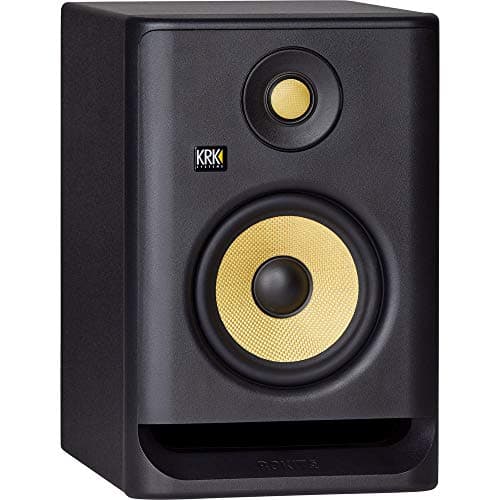
KRK Rokit RP5 G4 Studio Monitor
9.1 / 10
- 5" Kevlar woofer, 1" Kevlar tweeter — bi-amped Class D
- DSP room correction via free KRK app (iOS/Android)
- Balanced XLR + TRS + RCA inputs
- Built-in LCD visual EQ display
$179
Yamaha
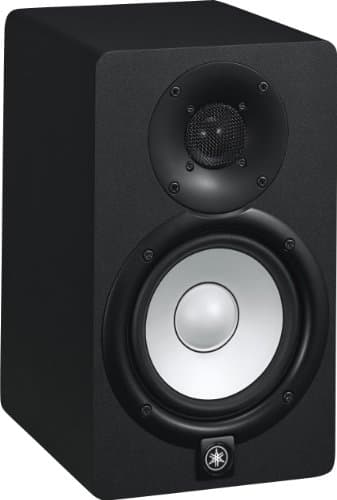
Yamaha HS5 Powered Studio Monitor
9.0 / 10
- 5" cone woofer, 1" dome tweeter — bi-amplified
- Frequency response: 54Hz–30kHz
- Room Control and High Trim response controls
- Balanced XLR and TRS inputs
$200
PreSonus
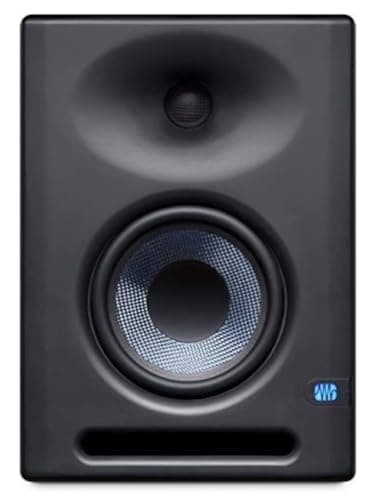
PreSonus Eris E5 XT Studio Monitor
8.6 / 10
- 5.25" woven composite LF driver, 1" silk-dome HF driver
- EBM (Elliptical Boundary Modeled) waveguide — wider sweet spot
- Frequency response: 48Hz–22kHz
- Balanced XLR, TRS, and RCA inputs
$170
Adam Audio
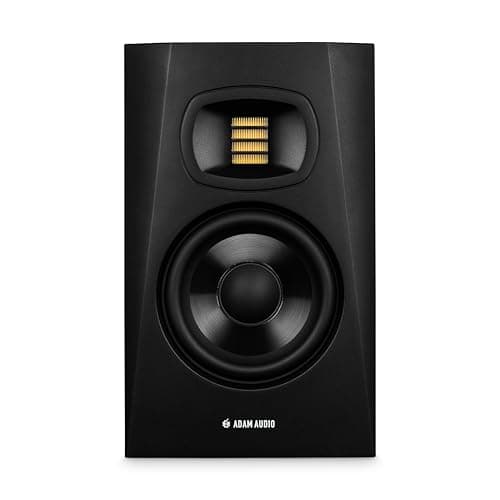
Adam Audio T5V Studio Monitor
8.9 / 10
- 5" woofer + U-ART folded ribbon tweeter
- High-frequency extension: up to 25kHz
- Precision waveguide with S Series dispersion characteristics
- Balanced XLR + TRS inputs
$300
The Short Answer
For most desk setups, the KRK Rokit RP5 G4 at ~$179/monitor is the industry anchor — DSP room correction via app, proven track record since 2019. Producers who want brutally honest mids should pick the Yamaha HS5 (~$200/monitor). Budget buyers get the most for money with the PreSonus Eris E5 XT (~$170/monitor). Critical detail listeners and mastering-adjacent work justifies the Adam Audio T5V (~$300/monitor). Prices listed are PER MONITOR — a stereo pair doubles the spend.
Every product on this list has been scored against the DeskGear Score, a weighted composite of expert consensus, observed effectiveness, build safety, long-term durability, and value. Review method: Editorial synthesis of trade-publication reviews (Wirecutter, SoundOnSound, Attack Magazine, MusicRadar, Audio Science Review), specialist audio reviewers, manufacturer documentation, and community data from r/WeAreTheMusicMakers, r/audioengineering, r/podcasting — no first-hand product testing.. Synthesized from 8+ expert sources.
Head-to-Head Comparison
| Feature | KRK Rokit RP5 G4 Studio Monitor | Yamaha HS5 Powered Studio Monitor | PreSonus Eris E5 XT Studio Monitor | Adam Audio T5V Studio Monitor |
|---|---|---|---|---|
| Price (per monitor) | $179 | $200 | $170 | $300 |
| Pair cost | ~$358 | ~$400 | ~$340 | ~$600 |
| Woofer size | 5" | 5" | 5.25" | 5" |
| Low-end extension | 50Hz | 54Hz | 48Hz | 45Hz |
| Room correction | DSP via app | Fixed Room Control | No | No |
| Tweeter type | Dome (Kevlar) | Dome | Dome (silk) | Ribbon (U-ART) |
| Best for | All-rounders / general production | Reference-accurate mixing | Budget home desk setup | Critical detail / mastering-adjacent |
| Check Price | Amazon | Amazon | Amazon | Amazon |
KRK KRK Rokit RP5 G4 Studio Monitor
$179
- 5" Kevlar woofer, 1" Kevlar tweeter — bi-amped Class D
- DSP room correction via free KRK app (iOS/Android)
- Balanced XLR + TRS + RCA inputs
- Built-in LCD visual EQ display
- 25W HF + 25W LF amplification per monitor
The KRK Rokit RP5 G4 is the studio monitor that appears most consistently across MusicRadar, SoundOnSound, and r/WeAreTheMusicMakers when someone asks for a desk monitor in the $150-$200 range. The reason is the same across every source: it delivers professional nearfield response with a DSP correction system that makes room acoustics a solvable problem rather than a permanent compromise.
The KRK app (free, iOS and Android) is the practical feature that separates the G4 from older generations and from competitors at this price. Connect via Bluetooth, run the built-in room acoustic analyzer, and the app generates a custom EQ curve for your specific desk position and room. This matters on a desk setup because near-field monitors are sensitive to early reflections from the desk surface and walls at typical 18-24" listening distances. The DSP correction improves imaging and low-end accuracy without requiring $500 worth of acoustic foam.
The Kevlar woofer and tweeter combination produces a frequency response that's honest without being harsh — which is why these monitors translate well. Mixes made on KRK RP5s tend to hold up on consumer speakers, which is the real-world test that matters.
What the spec sheet won't tell you: the 5" woofer has real limits below 50Hz. If your work is bass-critical — hip-hop, electronic, cinematic scoring where sub-bass decisions matter — you'll eventually want a subwoofer. And the KRK yellow accent on the woofer is a strong aesthetic that some home office setups find too studio-flashy.
Pricing note: $179 is per monitor. A stereo pair is ~$358. Most buyers purchase as a pair.
What We Love
- DSP room correction levels the playing field regardless of room acoustics
- Proven translation — mixes hold up on consumer speakers
- Wide input compatibility (XLR, TRS, RCA)
- Strong long-term reputation in r/WeAreTheMusicMakers
- Built-in LCD EQ display without needing the app
What Could Be Better
- 5" woofer needs a sub for bass-critical work below 50Hz
- KRK yellow woofer accent is polarizing aesthetically
- Bluetooth is app-control only — not audio transmission
The Verdict
The default studio monitor for podcasters, music producers, and video editors starting a serious desk audio setup. Buy as a pair at ~$358. Add a subwoofer later if bass accuracy becomes a priority.
Yamaha Yamaha HS5 Powered Studio Monitor
$200
- 5" cone woofer, 1" dome tweeter — bi-amplified
- Frequency response: 54Hz–30kHz
- Room Control and High Trim response controls
- Balanced XLR and TRS inputs
- 70W total amplification per monitor
The Yamaha HS5 descends directly from the NS-10 — a monitor so unforgiving that it became the professional standard precisely because it exposed mix problems other speakers buried under pleasant coloration. The HS5 carries that lineage into the modern era: a brutally honest midrange that shows you exactly what your mix sounds like before it goes to consumer speakers.
Wirecutter and Audio Science Review both flag this as the reference mixing pick for the same reason: the HS5 does not flatter. Bass that sounds impressive on consumer speakers often sounds thin here. Muddy mids that get lost on hi-fi speakers become obvious. Sibilance that slipped through on other monitors stands out clearly. For music producers and audio engineers, this is the feature, not the flaw.
The Room Control (low-shelf cut) and High Trim controls help adapt the monitor's response to desk placement without a DSP app — useful for near-field positions where boundary reinforcement from the desk surface builds up low-end.
What the spec sheet won't tell you: the HS5's flat reference response can feel less "musical" than the KRK on first listen. Producers coming from consumer speakers or hi-fi equipment often find the HS5's presentation dry and unexciting until mixes trained on it start translating to other systems. There is no DSP room correction — the Room Control is a fixed switch, not a parametric correction system. And like the KRK, the 5" woofer has real low-end limits — an HS8S subwoofer is the standard pairing for bass-critical work.
Pricing note: $200 is per monitor. A stereo pair is ~$400.
What We Love
- NS-10 reference lineage — the professional mixing standard
- Exposes mix problems before they reach consumers
- Room Control and High Trim adapt to desk placement
- Strong resale value — perennial professional recommendation
- 70W bi-amplification handles demanding material cleanly
What Could Be Better
- Less "musical" presentation — intentional but takes adjustment
- No DSP room correction (fixed Room Control switch only)
- 5" woofer limited below 54Hz — HS8S sub recommended for bass work
The Verdict
The monitor for producers and engineers who want the most honest possible reference at a desk. Harder to love on first listen than the KRK — and that is exactly the point.
PreSonus PreSonus Eris E5 XT Studio Monitor
$170
- 5.25" woven composite LF driver, 1" silk-dome HF driver
- EBM (Elliptical Boundary Modeled) waveguide — wider sweet spot
- Frequency response: 48Hz–22kHz
- Balanced XLR, TRS, and RCA inputs
- 80W bi-amplification per monitor
The PreSonus Eris E5 XT offers more specifications per dollar than either the KRK or Yamaha at a lower price point. The XT update added the EBM waveguide — an elliptical dispersion shaper that widens the horizontal sweet spot and improves high-frequency accuracy at desk distances where the listener is rarely perfectly centered on the tweeter axis. For a home office setup where chair position varies, wider dispersion is a practical advantage.
The 5.25" woven composite woofer extends to 48Hz — lower than the KRK's 50Hz and the Yamaha's 54Hz — which gives the E5 XT a slight low-end advantage without a subwoofer. Combined with 80W of bi-amplification (more than either competitor), the E5 XT handles dynamic material cleanly at desk listening levels.
What the spec sheet won't tell you: PreSonus is a smaller brand in the professional monitor segment, which has two real consequences. The secondary market resale value is weaker than KRK or Yamaha — if you plan to sell or upgrade in two years, you'll recover less. And professional studio environments where monitor brand signals credibility (client sessions, rental facilities) will notice the brand difference. For a home desk setup, neither factor matters.
Pricing note: $170 is per monitor. A stereo pair is ~$340.
What We Love
- Best low-end extension in this group without a sub (48Hz)
- EBM waveguide widens sweet spot for off-axis listening
- 80W amplification handles dynamic peaks cleanly
- Multiple input options including RCA for legacy gear
- Lower entry cost than KRK or Yamaha
What Could Be Better
- Weaker used-market resale than KRK or Yamaha
- Less brand recognition in professional studio contexts
- No DSP room correction
The Verdict
The best studio monitor value per dollar for home desk setups. Buy this when KRK/Yamaha prices feel unjustifiable for the use case and professional brand recognition doesn't matter.
Adam Audio Adam Audio T5V Studio Monitor
$300
- 5" woofer + U-ART folded ribbon tweeter
- High-frequency extension: up to 25kHz
- Precision waveguide with S Series dispersion characteristics
- Balanced XLR + TRS inputs
- 70W bi-amplification per monitor
The Adam Audio T5V sits at the top of this group's price range for a specific reason: the U-ART folded ribbon tweeter. Where dome tweeters (KRK, Yamaha, PreSonus) extend to 20-22kHz, the T5V's ribbon extends to 25kHz. The practical result is more resolved high-frequency detail — subtle sibilance, reverb tails, and harmonic overtones that dome tweeters compress. SoundOnSound and MusicRadar both flag this as the monitor for mastering-adjacent work where high-frequency accuracy is the deciding variable.
The precision waveguide is derived from Adam Audio's S Series — professional studio monitors found in mastering facilities. On a desk, the waveguide controls dispersion patterns to reduce reflections from the desk surface and side walls, improving the precision of the stereo image without acoustic treatment.
What the spec sheet won't tell you: the T5V's extended high-frequency resolution can feel hyper-detailed on first listen — some producers describe it as "too analytical" for pop or hip-hop production where the mix goal is feel over forensics. This is not a flaw, but it is a voicing difference from the KRK's warmer presentation. The learning curve is real: mixing on T5Vs takes an adjustment period to calibrate what you're hearing. And at ~$300 per monitor, the stereo pair investment is $600 — meaningful at this AOV.
Pricing note: $300 is per monitor. A stereo pair is ~$600.
What We Love
- U-ART ribbon tweeter resolves detail dome tweeters compress
- 25kHz extension captures transient and harmonic information
- S Series waveguide technology reduces reflection artifacts
- Mastering-studio voicing at a near-field price point
- Strong long-term build reputation in r/audioengineering
What Could Be Better
- Highest price in this group — $600/pair
- Overly analytical voicing for pop/hip-hop production workflows
- Learning curve — takes time to calibrate monitoring instincts
The Verdict
The monitor for producers, engineers, and podcasters who need the highest resolution reference available at a desk without moving to pro-level monitoring chains. Budget-fit: ~$600/pair.
How We Score
Formula
DeskGear Score = (Expert × 0.30) + (Effectiveness × 0.25) + (Build Safety × 0.20) + (Durability × 0.15) + (Value × 0.10)
Score Factors
- Frequency Response Accuracy · 30%
- Flatness of frequency response across the audible range, synthesized from Audio Science Review measurements, SoundOnSound reviews, and MusicRadar test reports. Penalizes significant coloration or manufacturer-tuned bass lift.
- Desk-Distance Performance · 20%
- Near-field performance at 18-36" listening distance, including sweet spot width, imaging precision, and dispersion characteristics for typical desk setups.
- Room Correction / Adaptability · 15%
- Available tools for adapting to desk placement and room acoustics — including DSP systems, EQ switches, and trim controls.
- Build / Long-term Reliability · 15%
- Durability reputation in r/WeAreTheMusicMakers and r/audioengineering ownership threads, materials quality, and manufacturer support reputation.
- Value · 20%
- Features and performance relative to per-monitor pricing. The PreSonus Eris E5 XT scores highest here for home desk use cases.
| Rank | Product | Score |
|---|---|---|
| #1 | KRK KRK Rokit RP5 G4 Studio Monitor | 9.1 |
| #2 | Yamaha Yamaha HS5 Powered Studio Monitor | 9.0 |
| #3 | Adam Audio Adam Audio T5V Studio Monitor | 8.9 |
| #4 | PreSonus PreSonus Eris E5 XT Studio Monitor | 8.6 |
Frequently Asked Questions
Do I need studio monitors if I mostly use headphones for mixing?
Headphones are better for isolation work — late-night sessions, detailed editing. Monitors reveal room acoustics and translate better to consumer speaker systems. Most serious workflows use both: headphones for tracking and detailed editing, monitors for final mix decisions. The two are complementary, not interchangeable.
Can I use one studio monitor as a single mono reference?
Yes, and this is a legitimate workflow — particularly for podcasters checking mono compatibility. A single monitor plus a subwoofer is also a viable budget approach for producers who want bass extension before committing to a full stereo pair. Most monitors are sold individually specifically to support this.
Are these monitors appropriate for listening at low volumes in an apartment?
Yes. All four picks perform well at near-field desk distances (18–36"), which means they're producing accurate results at moderate levels. Studio monitors do not need to be loud to work — the flat response is a property of the driver design, not the volume level.
What cables do I need to connect studio monitors to an audio interface?
Balanced TRS (quarter-inch) or XLR cables from the interface's monitor outputs to the speakers' inputs. Standard length for a desk setup is 1–2 meters per side. Most studio monitors do not ship with cables.
Is the KRK's DSP room correction worth paying for versus the PreSonus?
For desk setups in untreated rooms — which is most home offices — yes. The KRK app's acoustic analyzer measures reflections at your listening position and applies correction EQ automatically. The PreSonus's wider EBM waveguide partially compensates by reducing early reflections at the source, but it cannot correct low-frequency room modes the way DSP can. In a treated room, the difference narrows significantly.
Do studio monitors work for music listening, not just production?
Yes, though the experience is different from hi-fi speakers. Studio monitors reproduce music accurately rather than impressively — bass isn't emphasized, highs aren't shimmering. Some listeners prefer this precision; others find it fatiguing for long casual listening sessions. The KRK RP5 G4 is the most "listenable" in this group for non-production use.
Bottom Line
Buy the KRK Rokit RP5 G4 as the default desk studio monitor — DSP room correction, proven translation, ~$358/pair.
Buy the Yamaha HS5 if mix accuracy is the priority over musicality — the professional reference standard, ~$400/pair.
Buy the PreSonus Eris E5 XT for the best value — wider sweet spot, deeper low-end extension, ~$340/pair.
Buy the Adam Audio T5V for the highest resolution reference — ribbon tweeter detail at ~$600/pair.
Sources & Methodology
Expert review sources
- Wirecutter — studio monitor and desktop audio coverage
- SoundOnSound — professional studio monitor reviews and tests
- MusicRadar — studio monitor buying guides and reviews
- Attack Magazine — music production monitor recommendations
- Audio Science Review — measurement-based speaker and monitor reviews
- KRK, Yamaha, PreSonus, Adam Audio — manufacturer specifications
Community sources
- r/WeAreTheMusicMakers — studio monitor ownership and production advice
- r/audioengineering — professional and home studio monitor discussions
- r/podcasting — desk audio setup recommendations
Prices and specs verified May 9, 2026.
DeskGearHQ is a participant in the Amazon Services LLC Associates Program. We may earn commissions from qualifying purchases — at no extra cost to you.